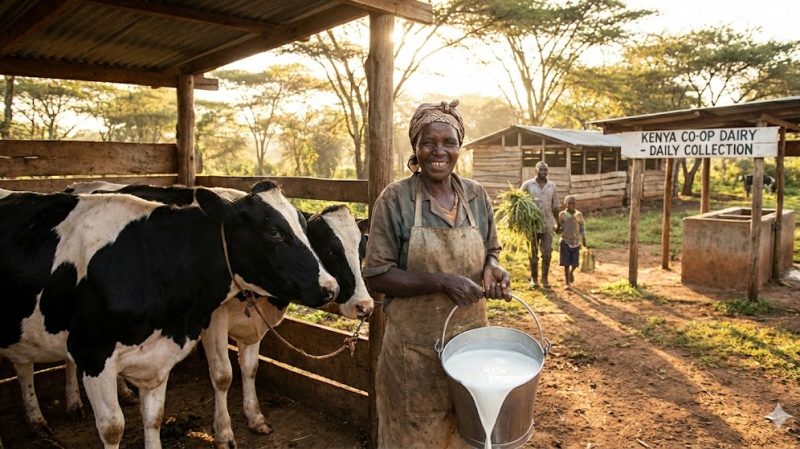

Strategic Contribution of Smallholder Dairy Farmers to Kenya’s Dairy Economy:
In Kenya, smallholder dairy farmers are not just participants in the agricultural landscape — they are central to the survival, growth, and resilience of the nation’s dairy economy. Representing the vast majority of milk producers and rural livelihoods, these farmers play a strategic economic, social, and nutritional role that underpins both rural communities and the national agricultural sector.
Smallholder Dominance in Kenya’s Milk Production
Smallholder dairy farmers are the backbone of Kenya’s dairy sector. Across the country, an estimated 1.8 million rural households depend on smallholder dairy production, collectively generating more than 80 % of all milk consumed and sold in Kenya today.
Predominantly operating on farms with just one to five dairy cows, these farmers are scattered across high-potential agricultural regions such as Kiambu, Nyeri, Meru, Nakuru, Uasin Gishu, Nandi, and other parts of the Central Highlands and Rift Valley. These areas alone account for roughly 80 % of the country’s milk output, driven largely by intensive smallholder systems.
Economic Impact and Contribution to GDP
The dairy sector, fuelled by smallholders, is one of Kenya’s most significant agricultural sub-sectors:
Dairy contributes about 3 %–4 % of Kenya’s national Gross Domestic Product (GDP) and roughly 12 % of agricultural GDP.
Through direct sales, local markets, and informal trading, dairy supports over 700,000 jobs across the value chain — from milking and feed suppliers, to transporters, traders, and milk vendors.
Given this profile, the dairy industry’s health — and therefore the fortunes of the wider Kenyan economy — are closely tied to the productivity and sustainability of smallholder farmers.
Livelihoods, Poverty Reduction, and Rural Development
For many rural households, dairy farming is more than an agricultural activity — it is a critical source of income and nutrition:
Regular milk sales provide families with predictable earnings needed for school fees, healthcare, and household essentials.
Dairy contributes to food security and improved nutrition, especially for children and vulnerable populations, because milk and its by-products are rich sources of protein, fats, and micronutrients.
Beyond farm gate earnings, smallholder dairy systems generate employment: they create jobs in milk collection, trading, transport, and informal market networks.
In many rural communities, these benefits extend into poverty alleviation pathways, empowering farmers to invest in assets, improve housing, and sustain multigenerational livelihoods.
Formal and Informal Market Linkages
Despite producing the bulk of the nation’s milk, smallholder farmers face a highly fragmented market:
Only a relatively small portion of milk enters formal processing plants — about 15 % of total production — with the remaining bulk traded through informal channels such as milk bars, roadside vendors, and doorstep deliveries.
Informal markets are crucial for income, as they often offer immediate cash payments and flexible buying arrangements to farmers who lack access to formal cooperative or commercial processors.
However, this informal dominance also poses challenges, including inconsistent quality standards and limited value addition — factors that constrain Kenya’s ability to increase exports or penetrate regional dairy markets more competitively.
Local Success Scenarios: Cooperative and Individual Initiatives
Across Kenya, there are tangible examples of how smallholder dairy initiatives contribute economically:
Cooperative success: Dairy co-operatives such as those in Githunguri (central Kenya) have empowered smallholders to pool milk, access better pricing, and invest in processing facilities. These societies have helped members secure more stable incomes and enhanced bargaining power with buyers.
Entrepreneurial growth: Individual smallholders have harnessed training and better practices to scale operations. In counties like Machakos, farmers have transitioned from single-cow holdings to mid-sized operations (30+ cows), and some now offer training programs to peers on genetics, forage management, and dairy business skills.
Such scenarios underline the dual nature of smallholder dairy farming: deeply rooted in local rural economies while also capable of driving entrepreneurial growth.
Challenges That Temper the Sector’s Potential
Despite their strategic importance, smallholder dairy farmers face persistent obstacles:
Input and production costs: High feed costs and poor-quality fodder account for a large portion of production expenses, limiting growth potential and profitability.
Infrastructure gaps: Poor rural road networks, insufficient cooling and storage facilities, and inconsistent power supply reduce market access and lead to significant post-harvest losses.
Limited access to financing and credit facilities often prevents farmers from investing in improved breeds, housing, and animal health services.
Addressing these constraints through improved policies, better access to markets, and enhanced public-private partnerships is critical for unlocking the full potential of smallholder dairy systems.
Cornerstone of Growth
Smallholder dairy farmers are more than producers — they are strategic contributors to Kenya’s dairy ecosystem, rural resilience, and economic growth. Their dominance in production, deep social impact, and role in sustaining both formal and informal markets make them indispensable to national agricultural development.
However, for Kenya to fully harness this potential — including expanding value addition, improving incomes, and boosting exports — sustained investment, policy support, and infrastructure development will be vital. Empowering smallholders not only reinforces the dairy sector but accelerates broader socioeconomic progress across rural Kenya.