
Powering the Future of Farming: Solar-Powered Irrigation and Smart Control Technologies Transform Agriculture
As climate change, water scarcity, and the global push for sustainable food systems reshape modern agriculture, a quiet revolution is unfolding in fields and farms across the world. At the heart of this transformation lies a powerful convergence of clean energy and intelligent systems—solar-powered irrigation combined with smart control technologies.
Together, they are redefining how farmers manage water and energy, driving efficiency, increasing yields, and reducing environmental impact. What once required diesel pumps, manual labor, and imprecise watering now operates under the sun and at the tap of a smartphone.
The Irrigation Imperative
Irrigation is a cornerstone of productive agriculture. According to the Food and Agriculture Organization (FAO), irrigated agriculture represents 20% of cultivated land but contributes 40% of total food production worldwide. However, traditional irrigation practices—especially those reliant on fossil fuels and inefficient water use—are becoming increasingly unsustainable.
Farmers in developing countries often struggle with erratic fuel supply and high operational costs. Meanwhile, water mismanagement exacerbates soil degradation and depletes already stressed aquifers. As extreme weather events become more common, the need for reliable, eco-friendly, and precise irrigation solutions has never been more urgent.
Solar-Powered Irrigation: Harnessing the Sun for Water
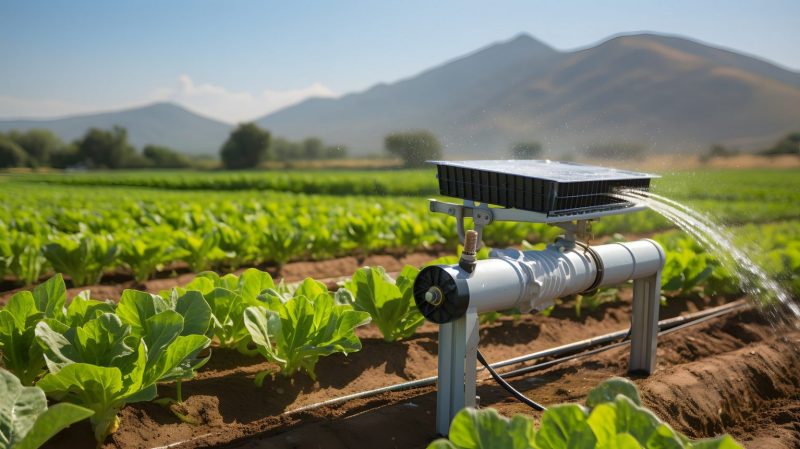
Solar-powered irrigation systems (SPIS) use photovoltaic panels to convert sunlight into electricity, which powers water pumps that draw water from sources such as rivers, wells, or storage tanks. These systems are often integrated with storage batteries or use direct current (DC) to optimize energy use.
Key Advantages:
Energy Independence: Farmers are no longer tethered to expensive diesel or unreliable grid electricity.
Environmental Benefits: Solar irrigation eliminates carbon emissions and reduces the carbon footprint of agriculture.
Cost Savings: After initial setup, operating costs are minimal, leading to long-term financial savings.
Scalability: Modular solar arrays can be scaled up or down to suit smallholder farms or large-scale operations.
In India, for example, government subsidies have led to the deployment of more than 250,000 solar irrigation pumps, with ambitious targets to install millions more in the coming years. Sub-Saharan Africa has also seen a surge in off-grid solar irrigation, supported by NGOs and green energy startups.
The Smart Revolution: IoT and Precision Control
Solar power solves the energy issue—but what about efficiency and precision?
Enter smart control technologies powered by the Internet of Things (IoT), artificial intelligence (AI), and big data. These technologies are transforming irrigation from a time-based to a data-driven system that reacts to real-time conditions on the ground.
Key Components:
Soil Moisture Sensors: Measure the amount of water in the soil to prevent over- or under-watering.
Weather Forecast Integration: Adjust irrigation schedules based on upcoming rainfall or temperature fluctuations.
Mobile and Web Apps: Allow farmers to monitor and control irrigation remotely, receiving alerts and recommendations.
Automation Systems: Use AI to make real-time decisions, activating pumps and valves only when needed.
Precision irrigation not only saves water but also enhances plant health, improving yield and quality. In areas facing water scarcity, these technologies can reduce water use by up to 60% while maintaining or even increasing productivity.
Real-World Impact: Case Studies
1. Kenya – Off-Grid Solar with Smart Monitoring
A cooperative in Nakuru County implemented a solar irrigation system with cloud-connected sensors. Farmers reported a 40% increase in tomato yields and a 30% reduction in labor costs within one season.
2. California – IoT-Driven Water Management in Vineyards
Wineries in Napa Valley use soil sensors and satellite imaging to target irrigation with pinpoint accuracy. Smart systems have helped them cut water use by 50%, critical in a state where drought is a constant threat.
3. India – Government-Backed Solar-Linked Drip Systems
Through the PM-KUSUM scheme, smallholder farmers are receiving solar pumps and training to integrate with drip irrigation. This has improved crop diversity, allowing for higher-value crops such as vegetables and pulses.
Challenges and Barriers
Despite their promise, solar-powered and smart irrigation technologies face several challenges:
High Upfront Costs: Initial investment can be a barrier, especially for smallholders without access to credit.
Technical Knowledge: Farmers may lack the expertise to install, operate, and maintain advanced systems.
Infrastructure Gaps: Remote areas may struggle with connectivity needed for real-time data exchange.
Policy and Support: Inconsistent government policies and subsidy structures can slow adoption.
However, partnerships between governments, NGOs, agri-tech companies, and financial institutions are beginning to bridge these gaps.
The Road Ahead: Integration and Innovation
The future of solar-powered smart irrigation lies in deeper integration—with satellite imagery, machine learning, and climate-resilient crop modeling enhancing predictive accuracy. Micro-financing models and pay-as-you-go systems are helping democratize access.
As regenerative agriculture and sustainable farming become more than buzzwords, the role of clean energy and smart water use will only grow. The shift is not just technological but philosophical: from extractive practices to resilient, circular systems that work with nature, not against it.
Conclusion
Solar-powered irrigation and smart control technologies are more than tools—they’re enablers of a new agricultural paradigm. One where food security, environmental stewardship, and farmer empowerment coexist.
For millions of farmers across the globe, the path forward is clear. It begins with a solar panel, a smart sensor, and a commitment to growing not just crops—but a more sustainable future.
Sources & References:
Food and Agriculture Organization (FAO)
International Water Management Institute (IWMI)
World Bank Agriculture Innovation Systems
International Renewable Energy Agency (IRENA)
PM-KUSUM Scheme, Ministry of New and Renewable Energy, India.