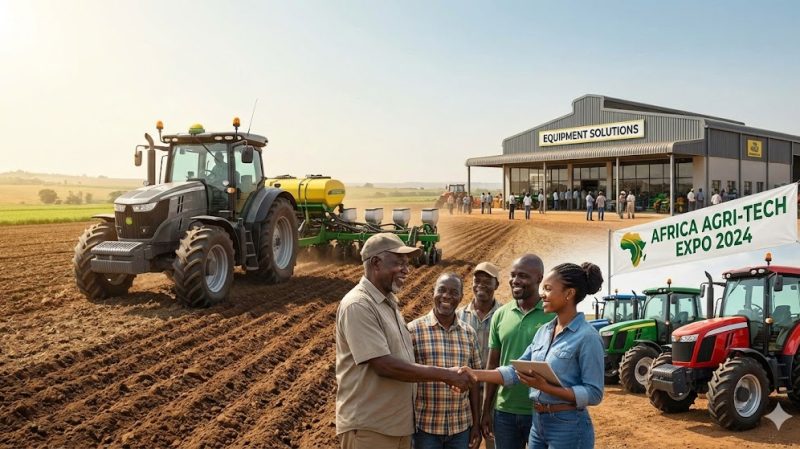

After several challenging seasons marked by climate volatility, supply-chain disruptions and constrained access to finance, confidence is gradually returning to Africa’s agricultural sector. This renewed optimism is now translating into a measurable recovery in farm machinery sales across key markets, signalling a broader shift towards mechanisation, productivity and long-term resilience.
A market emerging from uncertainty
In recent years, African farmers faced a convergence of pressures. Rising input costs, erratic rainfall patterns and global economic headwinds delayed capital investment, particularly in high-value equipment such as tractors, harvesters and precision implements. As a result, machinery replacement cycles were extended and many operators relied on ageing fleets.
However, improved commodity prices, more stable macroeconomic conditions in parts of the continent and increased policy focus on food security are reshaping sentiment. From commercial producers in Southern Africa to emerging medium-scale farmers in East and West Africa, confidence levels are improving, encouraging renewed investment in modern farm equipment.
Policy support and food security priorities
Government intervention has played a central role in restoring momentum. Across Africa, agriculture remains a strategic priority, underpinning employment, rural development and national food security. In response, several governments have expanded support mechanisms, including input subsidies, mechanisation schemes and concessional finance programmes.
Public–private partnerships are also gaining traction, enabling farmers to access machinery through leasing models, shared ownership and service providers. These approaches are particularly impactful in regions where upfront capital costs remain a barrier. By lowering the entry threshold for mechanisation, they are stimulating demand for tractors, planters, irrigation systems and post-harvest equipment.
Mechanisation as a productivity imperative
The recovery in machinery sales reflects a deeper structural shift. Africa’s agriculture sector is under increasing pressure to improve yields, reduce post-harvest losses and operate more efficiently on limited arable land. Mechanisation is no longer viewed as optional, but as essential to meeting growing food demand and competing in regional and export markets.
Modern machinery enables timely land preparation, precision planting and efficient harvesting, directly improving output and profitability. In labour-constrained environments, mechanisation also addresses workforce shortages while supporting younger, technology-oriented farmers entering the sector.
Technology and the rise of “smart” equipment
A notable trend within the recovery is the growing appetite for technologically advanced machinery. Precision agriculture tools, GPS-enabled tractors, telematics systems and data-driven fleet management solutions are increasingly visible in African markets. While adoption varies by region, larger commercial farms and agribusinesses are leading the transition.
Manufacturers and distributors are responding by tailoring offerings to African operating conditions, focusing on durability, fuel efficiency and ease of maintenance. Digital platforms that support predictive maintenance and remote diagnostics are helping to reduce downtime and strengthen the value proposition for buyers.
Financing remains a key determinant
Despite improving confidence, access to finance remains uneven. Interest rates, currency volatility and credit risk perceptions continue to influence purchasing decisions, particularly among small and medium-scale producers. Where tailored agricultural finance products are available, machinery sales show stronger recovery trends.
Development finance institutions, commercial banks and equipment manufacturers are increasingly collaborating to structure flexible financing solutions. These include seasonal repayment schedules aligned with harvest cycles and bundled packages combining equipment, training and after-sales support.
Regional dynamics shaping demand
The recovery in farm machinery sales is not uniform across the continent. Southern Africa, with its established commercial farming base, continues to lead demand for high-horsepower tractors and advanced harvesting equipment. East Africa is seeing steady growth driven by horticulture, dairy and grain production, while West Africa’s demand is closely linked to rice, maize and cassava value chains.
In North Africa, irrigation and water-efficient machinery are key growth segments, reflecting water scarcity challenges and the need for resource optimisation.
Outlook: cautious optimism
Looking ahead, the outlook for Africa’s farm machinery market is cautiously optimistic. Sustained recovery will depend on continued policy support, stable economic conditions and ongoing investment in rural infrastructure. Climate resilience and sustainability considerations are also expected to shape purchasing decisions, with demand rising for equipment that supports conservation agriculture and efficient resource use.
As confidence continues to return to the agricultural sector, the rebound in farm machinery sales signals more than a cyclical recovery. It reflects a broader commitment to modernising African agriculture, strengthening food systems and positioning the sector for long-term growth in an increasingly competitive global environment.