
Advanced Humidity Management for Commercial Greenhouses:
In the high-stakes world of commercial horticulture, humidity is the silent adversary. It’s the invisible hand that invites pathogens like Botrytis (grey mold) and powdery mildew, destroys crop uniformity, and forces growers into an expensive battle against nature. For decades, the weapons of choice have been electric refrigerant dehumidifiers or the crude, energy-wasting method of venting and heating. But a powerful, multi-functional alternative is changing the game: the propane-fired desiccant dehumidifier.
This technology isn’t just a new way to dry air; it is a fundamental shift in how greenhouses manage climate. By adopting propane dehumidification, growers can revolutionize their operations, turning humidity control from a costly headache into a yield-boosting asset.
The Flaws of Traditional Humidity Control
To understand the revolution, you first need to understand the problem. In a sealed or semi-sealed greenhouse, plants transpire massive amounts of water. As temperatures drop when lights go off or the sun sets, the air’s ability to hold that moisture decreases, causing relative humidity to spike.
The standard response is the electric refrigerant dehumidifier. These units work like an air conditioner, cooling air over cold coils to condense water into liquid. They are effective in warm environments, but their efficiency plummets when temperatures dip below 65°F (18°C). In the cool night conditions where humidity is most dangerous, these units often freeze up and fail, consuming electricity while doing little to protect the crop.
The other common method is “burping” the room—venting warm, moist air outside and pulling in cold, dry outdoor air, which then must be heated. This method is incredibly wasteful. You are literally blowing your heating budget out the window, only to pay to heat up cold air again. It creates an unstable climate and massive energy bills.
The Propane Dehumidifier Advantage: The “Triple Threat”
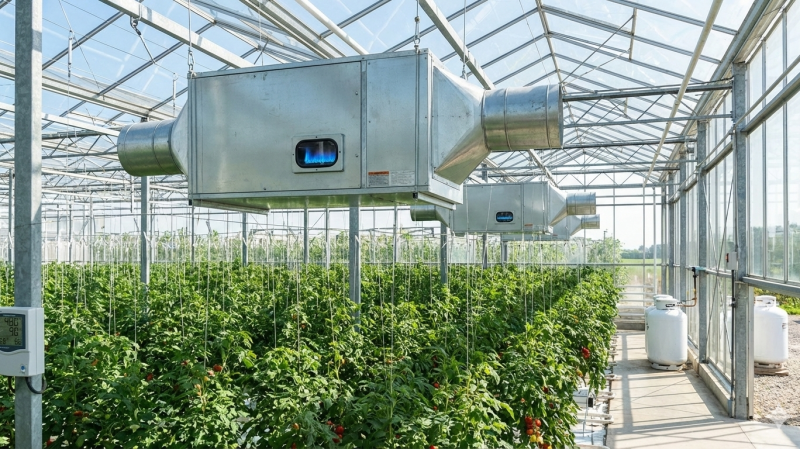
Propane-fired dehumidifiers operate on a completely different principle, using a desiccant material that attracts moisture from the air like a sponge. A burner, fueled by clean-burning propane, generates heat to dry out (regenerate) this desiccant wheel so it can keep absorbing moisture continuously.
This process solves the traditional problems and offers a “triple threat” of benefits that electric units simply cannot match.
1. Superior Performance in Cold Climates Unlike refrigerant units that rely on cooling already cool air, propane desiccant units rely on heat. This means their performance is independent of the room’s temperature. They can aggressively pull moisture from the air even in cold greenhouse conditions, ensuring you maintain optimal Vapor Pressure Deficit (VPD) continuously, preventing the conditions that mold requires to thrive.
2. “Free” Supplemental Heat The regeneration process requires heat, and that heat doesn’t just disappear. It is returned to the greenhouse as warm, dry air. In cooler climates or during shoulder seasons, this byproduct heat is an immense benefit. A propane dehumidifier essentially acts as a secondary heater, significantly reducing the load on your primary boiler or HVAC system. You are no longer just paying to remove water; you are paying for heat and getting dehumidification as part of the package.
3. Supplemental CO2 Enrichment Carbon dioxide is the basic building block of plant life. Commercial growers often spend significant money on CO2 burners or bulk tanks to elevate levels to 800–1200 ppm to maximize photosynthesis and yields.
When propane burns cleanly, the primary byproducts are water vapor (which is immediately removed by the desiccant wheel) and pure CO2. Propane dehumidifiers are designed to exhaust this clean CO2 directly back into the grow environment. By running your dehumidifier, you are simultaneously supplementing your plants with the gas they need to grow heavier and denser. It eliminates the need for separate CO2 burners in many setups.
Closing the Loop
The modern greenhouse is moving toward a “closed-loop” system, where every input is maximized and waste is minimized. Venting heat outside is the antithesis of this philosophy.
Propane dehumidifiers perfectly align with closed-loop principles. They allow you to seal up the greenhouse, retaining your expensive heat, while effectively managing the moisture your plants create. They take a single input—propane—and convert it into three valuable outputs: dry air, heat, and CO2.
For commercial growers looking to improve crop consistency, reduce energy waste, and eliminate the threat of mold, it’s time to move beyond the limitations of electric units. It’s time to revolutionize humidity control with propane.