
WILDFIRE READY: Essential Fire Prevention, Detection & Suppression Solutions for Modern Farms:
Preparing farms for the dry season with smarter prevention, earlier detection and faster response.
As harvest activity winds down and the landscape begins to dry, farmers across fire-prone agricultural regions face a familiar but increasingly important challenge: preparing their farms for wildfire and veld-fire risks. Dry grass, crop residues, vegetation, strong winds and accumulated combustible materials can quickly transform a small ignition into a serious threat to crops, livestock, machinery, buildings and livelihoods.
For modern agriculture, wildfire preparedness can no longer be treated simply as an emergency response issue. It is becoming an integral part of farm risk management, business continuity, asset protection and long-term agricultural resilience. The message is straightforward: the best time to prepare for a farm fire is before there is smoke on the horizon.
The Post-Harvest Fire-Risk Window
The period immediately following harvest deserves particular attention.
Fields may contain crop residues, dry vegetation and other combustible material, while surrounding grasslands and uncultivated areas can become progressively drier as the season advances. Farm roads, storage areas, machinery yards, fences and buildings can also become exposed to rapidly spreading fires.
The risk is not limited to agricultural fields.
A wildfire can threaten:
- Farmhouses and workers’ accommodation
- Livestock facilities
- Grain and produce storage
- Irrigation infrastructure
- Agricultural machinery
- Fuel and chemical storage areas
- Workshops and processing facilities
- Electrical installations
- Fencing and access infrastructure
- Export crops and stored agricultural products
A comprehensive fire strategy therefore needs to consider the entire farm operation, rather than focusing on fields alone.
Fire readiness is becoming an essential component of modern farm resilience.
From Fire Risk Assessment to Fire Readiness
Effective fire protection begins long before firefighting equipment is deployed.
Farm managers should undertake a systematic assessment of areas where fire could start, spread or cause significant damage. This includes identifying combustible vegetation, machinery areas, electrical installations, fuel storage, buildings and difficult-to-access locations.
The assessment should also consider how emergency responders and farm personnel would reach different areas during a fire.
Questions worth asking include:
Where is the greatest fire risk?
Where can a fire spread most rapidly?
Where are people, livestock and valuable assets most vulnerable?
How quickly can firefighting equipment reach those locations?
Where is the nearest reliable water supply?
Can workers communicate effectively during an emergency?
These questions form the foundation of a practical farm fire-readiness plan.
Firebreaks: The First Line of Defense.
Well-planned firebreaks remain an important element of wildfire prevention.
Their purpose is to reduce the availability of combustible vegetation and create strategic separation between areas that could allow fire to spread and important assets that need protection.
However, firebreaks should not simply be regarded as strips of cleared land. Their effectiveness depends on appropriate planning, maintenance and consideration of the local environment, terrain, vegetation and prevailing fire conditions.
Strategically positioned firebreaks can help protect:
- Farm buildings
- Livestock areas
- Orchards and plantations
- Crop fields
- Storage facilities
- Machinery yards
- Fuel installations
- Residential areas
Firebreak planning should form part of the farm’s broader vegetation-management and emergency-response strategy.
Early Detection: Every Minute Matters
Once a fire starts, time becomes critical.
Traditional observation remains useful, but modern technology is opening new possibilities for detecting fires earlier and monitoring high-risk areas more effectively.
Depending on the farm’s size, location and risk profile, technologies can include:
Thermal imaging cameras capable of identifying abnormal heat signatures, remote monitoring systems, environmental sensors, automated alerts, drones and other digital surveillance technologies.
Satellite-based monitoring can also provide valuable information for larger agricultural regions and fire-prone landscapes.
The objective is not technology for its own sake. It is to shorten the gap between ignition, detection, notification and response.
Earlier detection can provide farm personnel with more time to assess the situation, initiate emergency procedures and bring appropriate firefighting resources into action.
Building the Farm’s Firefighting Infrastructure
Detection is only one part of the equation.
Once a fire has been identified, the farm needs the capability to respond.
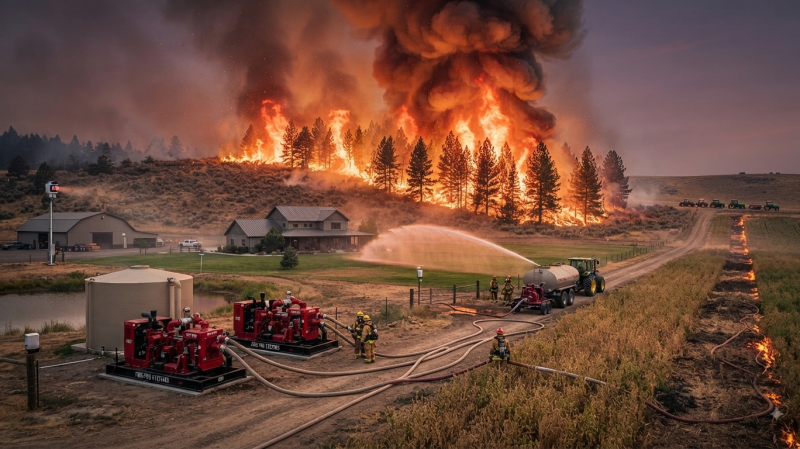
Reliable access to water can be fundamental to firefighting operations. Depending on the farm’s risk profile and infrastructure, this can involve appropriately designed:
- Water storage tanks
- Fire pumps
- Hoses and hose reels
- Hydrants
- Sprinkler systems
- Portable firefighting equipment
- Firefighting vehicles
- Water bowsers
- Emergency access points
The important consideration is that firefighting infrastructure should be planned around the farm’s actual requirements.
A small agricultural operation and a large commercial farming enterprise will have very different risks, distances, water requirements, infrastructure and response capabilities.
Professional fire-protection specialists can assist farmers in assessing these requirements and developing appropriate systems.
The Right Fire Extinguisher for the Right Risk
Portable fire extinguishers remain an important first-response tool, particularly around buildings, workshops, machinery areas and other locations where a small fire may initially be contained.
But extinguishers are not one-size-fits-all equipment.
Different types of fires require appropriate extinguishing agents and equipment. Farmers should therefore ensure that extinguishers are selected according to the identified risks, correctly positioned, regularly inspected and properly maintained.
Just as importantly, workers need to understand how and when to use them.
An extinguisher is only useful as a first-response tool when the equipment is accessible, appropriate and used safely by someone who understands its limitations.
Agricultural Machinery: A Potential Ignition Source.
Modern farms depend heavily on machinery.
Tractors, harvesters, trucks, generators and other equipment can operate for long periods under demanding conditions. Accumulations of dry plant material, dust, oil or other combustible substances around machinery can increase the potential for ignition.
Preventive maintenance therefore has a role in farm fire management.
Regular cleaning and inspection should form part of machinery-management procedures, particularly during periods of intensive field operations.
Attention should be given to:
- Accumulated crop residue
- Dust and combustible material
- Fuel and oil leaks
- Electrical systems
- Exhaust components
- Batteries and wiring
- Overheating components
- Machinery storage areas
A proactive approach can reduce avoidable ignition risks before machinery enters dry fields or high-risk areas.
Protecting People Comes First.
While protecting property and agricultural assets is important, human safety must remain the primary consideration during any fire emergency.
Farm workers should know what to do when a fire is discovered, who must be notified and where people should assemble.
A farm emergency plan should establish appropriate:
- Emergency contacts
- Communication procedures
- Evacuation routes
- Assembly points
- Worker responsibilities
- Livestock evacuation procedures where feasible
- Access arrangements for emergency services
Training should not be limited to management.
Workers who spend their days in fields, workshops, livestock facilities and machinery areas are often among the first people to identify unusual smoke, heat or other signs of a developing fire.
Livestock and Agricultural Assets Need Their Own Plan.
Livestock can be particularly vulnerable during rapidly developing fires.
Farmers should identify potential evacuation routes and safe areas where livestock can be moved when circumstances allow. Gates, fencing, water points and access routes should be considered during emergency planning.
The same principle applies to high-value agricultural assets.
Modern farms may contain millions of rands’ worth of machinery, irrigation systems, storage facilities, processing equipment and agricultural products.
Protecting these assets requires understanding where the greatest exposure exists and how quickly a fire could reach them.
Professional Fire-Protection Partners.
Fire preparedness does not have to be developed in isolation.
Specialist fire-protection manufacturers, equipment suppliers, system integrators and service providers can support agricultural businesses with risk assessments, equipment selection, system design, installation, inspection, maintenance and training.
For farmers, the most valuable relationship is not necessarily with a supplier offering a single product. It is with a professional partner capable of understanding the farm’s complete fire-risk environment.
That can help move the conversation from:
“What fire equipment should we buy?”
“What level of fire protection does our farm actually require?”
From Reactive Firefighting to Proactive Fire Resilience
The traditional approach to farm fires has often centred on responding once flames appear.
Modern agricultural risk management calls for something broader.
RISK → PREVENTION → DETECTION → PREPARATION → RESPONSE → SUPPRESSION → RECOVERY → RESILIENCE
Each stage contributes to reducing the potential impact of fire.
Risk assessment identifies vulnerabilities.
Prevention reduces the probability of ignition and fire spread.
Detection provides earlier warning.
Preparation ensures people, equipment and procedures are ready.
Rapid response helps prevent a developing incident from becoming a major disaster.
Suppression provides the capability to fight the fire.
Recovery helps the farm restore operations.
And ultimately, resilience means using what has been learned to strengthen the farm against future threats.
Investing Before the Emergency
For agricultural businesses, fire protection should be considered an investment in continuity rather than simply another operating expense.
A major farm fire can disrupt production, damage infrastructure, destroy equipment, threaten livestock, affect employees and interrupt supply commitments.
For farms involved in domestic and international agricultural markets, disruption can have consequences extending beyond the farm gate.
This is why the most effective fire strategy begins before the emergency.
Farmers should review their fire-readiness plans before the dry season reaches its most challenging conditions, verify that equipment is operational, inspect water supplies, maintain access routes, train personnel and address vulnerabilities identified during risk assessments.
Ready Before the Flames
Wildfires are not always predictable. Their direction and intensity can change rapidly, particularly under difficult weather and vegetation conditions.
But preparedness is within the farmer’s control.
The modern farm needs more than a fire extinguisher stored in a workshop or a water tank somewhere on the property. It needs a coordinated approach to prevention, detection, preparation and suppression.
As agriculture becomes increasingly technology-driven and asset-intensive, protecting the farm from wildfire is becoming part of protecting the business itself.